2022 Chevrolet Bolt EUV
All-Electric Bolt EUV is first Chevy to offer Super Cruise
Today, Chevrolet expanded its electric vehicle portfolio with the introduction of the new, all-electric 2022 Bolt EUV, alongside the redesigned 2022 Bolt EV.
Distinguished by unique exterior designs, including an SUV-like proportion for the new Bolt EUV, each is propelled by the proven technology that helped make the Bolt EV the industry’s first affordable, long-range electric vehicle — and both are part of General Motors’ plan to launch 30 new EVs globally by 2025.
“We want to put everyone in an EV and the new Bolt EUV and redesigned Bolt EV are crucial to doing so,” said GM President Mark Reuss. “Together, they enable mainstream customers to be part of our vison of zero crashes, zero emissions and zero congestion.”
The Bolt EV has led the charge in putting more drivers in electric vehicles. Since its market introduction in 2017, global sales have topped 100,000 and it has generated some of the best satisfaction and loyalty ratings in the industry. In the U.S., three-quarters of Bolt EV buyers are new to GM.
“The new Bolt EUV is the best of the Bolt EV packaged in an SUV-like vehicle with more technology and features, giving customers more choices and reasons to switch to electric,” said Steve Hill, vice president of Chevrolet. “This is an opportunity for Chevy to capitalize on the success we’ve built with the Bolt EV and bring new customers into the Chevy family.”
Along with broadening the brand’s electric vehicle lineup, the Bolt EUV will also be the first Chevrolet vehicle to offer Super Cruise
1, the industry’s first true hands-free driver assistance system for enabled roads.
Chevrolet is also making charging more convenient with a new Dual Level Charge Cord, which, for many customers, will eliminate the need to purchase a separate charger for their home. It has a changeable plug that allows the customer to plug into a standard 120-volt three-prong outlet for Level 1 charging and a 240-volt outlet for Level 2 charging up to 7.2 kilowatts.
The new Dual Level Charge Cord is standard with Bolt EUV and is available for Bolt EV. For maximum Level 2 charging speed, both vehicles are now capable of 11 kW Level 2 charging, but separate charging equipment (not included) is required.
Additionally, Chevrolet will cover standard installation of Level 2 charging capability for eligible customers who purchase or lease a 2022 Bolt EUV or Bolt EV, helping even more people experience how easy it is to live electric. In collaboration with Qmerit, the offer gives customers access to faster charging right where they want it — at home — and with the new available Dual Level Charge Cord, a standalone charging station is not required
2.
When it comes to on-the-go public charging, General Motors is providing customers with convenient and expanded access. GM and EVgo, the nation’s largest public fast-charging network, are collaborating to
triple the number of fast chargers, with the addition of more than 2,700 chargers around the country by the end of 2025.
Chevrolet customers also have location access to more than 80,000 chargers in North America through the Energy feature within their myChevrolet app
16. It enables owners to plan and manage their routes more efficiently, locate available charging stations along their route, receive real-time alerts about range and easily pay for public charging through the click-to-charge feature.
The starting price for both vehicles is less than the 2021 Bolt EV. The 2022 Bolt EUV is priced from $33,995
3 (including destination freight charge), and the 2022 Bolt EV starts at $31,995
3 (including DFC), before any available state, local or utility incentives. Both will be available this summer.
“We’ve lowered Bolt EV’s base price by more than $5,000 from the 2021 model, proving our commitment to make EVs attainable for everyone,” added Hill.
A special, limited-production Launch Edition of the Bolt EUV is also available, offering the Super Cruise
1 driver assistance feature, sunroof, unique wheels, special badging and an illuminated charge port for $43,495
3 (including DFC). Customers can reserve the Launch Edition now at
www.chevrolet.com.
Design distinctions
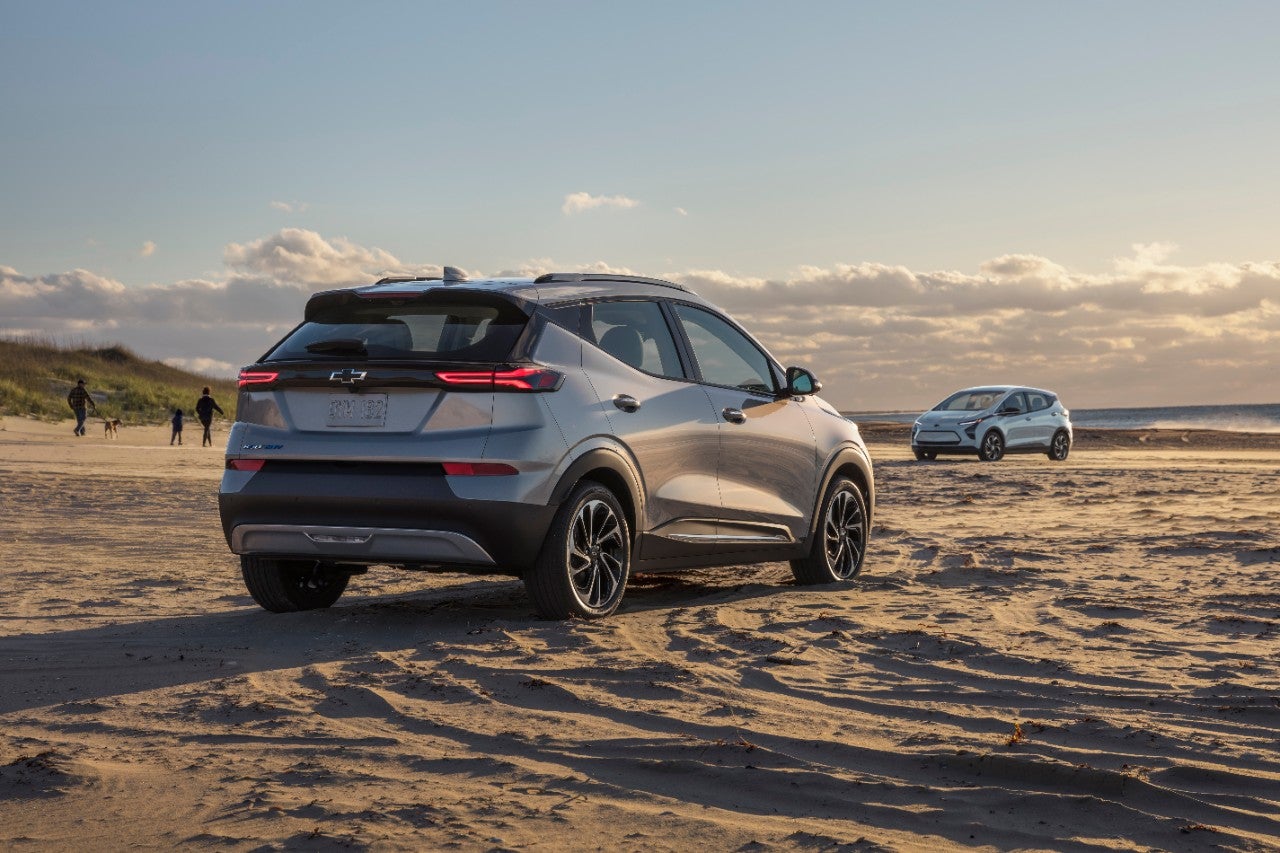
The new Bolt EUV and redesigned Bolt EV share an architecture, but their designs are unique. No exterior sheet metal parts are shared between the two vehicles and the EUV is approximately 6 inches longer.
“The new Bolt EUV and Bolt EV build on our bold and athletic Chevrolet SUV design themes, but are executed in a uniquely electric way,” said Phil Zak, executive design director, Chevrolet. “These two designs feature excellent proportions and tech-focused interiors, with more premium materials, which are key to our growing EV portfolio.”
Bolt EUV brings its own character to the growing small SUV segment with a modern, muscular design and a roomier interior and ample rear legroom. It also features a distinctive front-end with a sculpted grille and signature lighting, including standard LED headlamps and Chevy’s brand-specific, high-eye daytime running lamps, which double as sequential turn-signal indicators.
Additional Chevy SUV styling cues on the EUV include a center crease line that runs from the front fascia through the hood and seamless horizontal body lines that give a sense of motion even when the vehicle is standing still. Standard roof rails also reinforce the SUV aesthetic.
For Bolt EV, the design updates include a new, more upright front fascia and new front and rear lighting signatures — including the signature high-eye daytime running lights in front.
Inside, both vehicles feature new instrument panels, vehicle controls and seats, with a 10.2-inch-diagonal infotainment
4 color touchscreen and integrated climate controls common to both for clean, intuitive interfaces. The infotainment screen features real-time displays with more details available on the 8-inch-diagonal reconfigurable color gauge cluster.
There’s also a new, electronic gear shift design that uses pull toggles and push buttons to free up more interior space. For increased regenerative braking, there’s even a new one-pedal driving button that keeps the system active between drive cycles.
The new interior includes a sporty, flat-bottom steering wheel that incorporates the Regen on Demand paddle and a black Chevy “bowtie” emblem. Additionally, the redesigned seats feature a triangular geometric pattern and contrasting color stitching — premium design that gives a consistent and upscale atmosphere, while also complementing the new instrument panel and steering wheel designs.
When it comes to spaciousness, the all-new Bolt EUV expands on the Bolt EV’s already roomy cabin, with 3 inches of additional rear legroom. Heated and ventilated front seats and heated rear outboard seats are available, along with a panoramic power sunroof for Bolt EUV.
Super Cruise1 and additional technologies
The 2022 Bolt EUV is the first Chevrolet offered with Super Cruise
1, the industry’s first true hands-free driver assistance technology for enabled roads. It can be used on more than 200,000 miles (320,000 km) of enabled roads in the U.S. and Canada.
Super Cruise employs many advanced technology features, including a Driver Attention System and precision LiDAR map data. The Driver Attention System uses a small camera located on the top of the steering column and works with infrared lights to determine where the driver is looking whenever Super Cruise is in operation.
If the Driver Attention System detects the driver’s gaze has turned away from the road ahead for too long, the steering wheel light bar will prompt the driver to return their attention to the road. If the system determines continued inattentiveness, it will use visible and audible alerts to notify the driver to take back control of the wheel. Super Cruise is available on Bolt EUV Premier.
Chevy Safety Assist
5 is standard on both Bolt EUV and Bolt EV and includes safety and advanced driver assistance technologies, such as Automatic Emergency Braking, Forward Collision Alert, Lane Keep Assist with Lane Departure Warning, Following Distance Indicator, IntelliBeam and Front Pedestrian Braking.
Available driver assistance technologies for both vehicles include Rear Cross Traffic Alert
5, HD Surround Vision
5 and Adaptive Cruise Control
5. HD Rear Vision Camera
5 is standard on both Bolt EUV and Bolt EV.
Additional connectivity technologies offered in the Bolt EUV and Bolt EV include new wireless Apple CarPlay
6 and Android Auto
7 phone projection capability, as well as wireless phone charging
8 that is standard on Bolt EUV and available on Bolt EV, and an available 4G LTE Wi-Fi® Hotspot
9.
Also, new In-Vehicle Apps
10 allow users to browse a list of available apps such as Alexa
11, Spotify
12, The Weather Channel and many more, and install them on the infotainment system
4. With Alexa, drivers can use simple voice commands, while keeping their eyes on the road and their hands on the wheel. Alexa can play music, get directions, place calls, listen to audiobooks, control your smart home
13, access tens of thousands of Alexa skills and more — just ask, and Alexa will respond.
Proven propulsion system
Powering the Bolt EUV and Bolt EV is the proven battery technology that helped make the Bolt EV the industry’s first affordable long-range electric vehicle.
An advanced 65 kilowatt-hour, lithium-ion battery pack helps the Bolt EV deliver up to a GM-estimated 259 miles of range (416 km) on a full charge
14. With the slightly larger Bolt EUV, the GM-estimated range on a full charge is 250 miles (402 km)
14.
The battery system features Chevy’s proven active thermal management system, which uses coolant to maintain the battery at its ideal operating temperature. This technology is a primary enabler of Chevrolet’s 8-year/100,000-mile limited battery system warranty
15.
Additionally, standard DC fast public charging capability enables the Bolt EV to add up to 100 miles (160 km) of range in 30 minutes
16 and 95 miles (152 km) for Bolt EUV
16.
With the Chevrolet EV Access package, customers can remotely view their current charging status and battery charge level, customize their charge settings and set up charge notifications via the myChevrolet Mobile App
17. The Energy feature
18 within the myChevrolet Mobile App can help plan road trips by locating charging stations — including real-time availability — and start a charge session with participating charging networks.
Additional propulsion system highlights include:
- Single-motor drive unit that delivers 200 horsepower (150 kW) and 266 lb-ft (360 Nm) of near-instant torque
- Regen on Demand that allows the driver to convert kinetic energy into energy stored within the battery for future use by simply pulling on a steering wheel-mounted paddle
- One Pedal Driving lets the driver speed up, slow down and even come to a complete stop using only the accelerator pedal19
The 2022 Bolt EUV and Bolt EV were introduced through a special, 90-second commercial titled “Magic is Electric
,” which was made in collaboration with Walt Disney World Resort
. It can be viewed at
www.chevy.com/EV.